

Visual Payload Architecture v2
on this page
Posture
This artifact models the content axis of the definition layer: the per-image visual dimensions and set-level visual relationships carried by visual outputs, plus the lifecycle roles that dimension-specific statements may occupy from intended specification through governance. It is the v2 correction of the content-axis model: same purpose as v1, corrected ontology and topology.
It is architecture, not prompting and not schema. It is aesthetic-agnostic: it
describes the shape of an image-payload system, not any brand's aesthetic. It reads
against the function-axis companion
(docs/layered-reference-and-discretion-architecture-v1.md),
the normative-force vocabulary
(docs/normative-force-and-durable-layer-pressure-v1.md),
and the foundational premises
(docs/foundational-premises-v1.md).
What changed from v1, and why
v1 named fifteen "payload families" as a flat peer list and drew their resolution as one linear inheritance lattice. An ontology/topology audit found that the list mixed four different kinds of object (realized payload, a cross-image relation, conformance relations, and external obligations/constraints), and that the linear lattice misdrew a convergence problem as a single lineage. v2 corrects this:
- the primary model is visual dimensions × lifecycle roles, not a flat family list;
- normative sources (the inherited scoped statements plus orthogonal resolution inputs) sit outside payload as what converges to specify the dimensions, with typed references as a cross-cutting carrier axis over them;
- resolution is a convergence at the slot that preserves the Axis-B scope spine rather than replacing it;
- normative force is a property of a statement about a dimension, not of the dimension itself.
v1 is preserved unchanged as predecessor evidence.
Two axes: content and function (preserved)
The reference-function taxonomy answers what role a reference plays; this artifact answers what visual information the image carries. They are orthogonal. Typed references are not a peer source of visual content — a reference is a carrier that anchors, evidences, or constrains statements across the sources (it can anchor lighting, product truth, composition, a prohibition, continuity). In the resolution picture below, references are a cross-cutting function axis, never one independent content branch.
A reference's governing role is assigned within the production ask; it is not intrinsic to the image carrier. The same image may function as product-truth evidence, a directional / scene anchor, a mood reference, a prohibition example, a continuity reference, or non-governing inspiration depending on the package's source of intent, scope, and carrier role. A reference does not carry its own instructions; the production ask states what each carrier governs — and what it does not.
The visual dimensions (content axis)
Per-image dimensions (12):
- subject / product depiction
- casting / pose / gesture
- use-state / action
- lighting
- color / palette / tonal treatment
- composition / framing / negative space
- optics / perspective / depth
- space / environment / background
- styling / props / wardrobe
- material appearance / behavior
- mood / atmosphere
- image finish / rendering character
Set-level dimension (1):
- family / sequence relationship — with two structurally different subtypes: family coherence (an unordered, set-based relation) and sequence / arc progression (an ordered, possibly temporal relation). Evidence earned for one does not transfer to the other.
Two boundaries are stated explicitly to prevent overlap defects:
- material appearance / behavior = properties of the depicted world (fabric weave, nap, reflectivity, drape, wood grain) vs image finish / rendering character = properties of the representation as an image (grain, smoothing, sharpening, bloom, halation, compositing character). Editing history is provenance, not finish.
- casting / pose / gesture = who appears and bodily configuration vs use-state / action = what is happening and the subject/product/action relationship. Coupled in realization; different architectural jobs.
The dimensions are separately articulable and governable, though coupled in realization — lighting moves material appearance, mood, and color; optics moves composition and space; image finish moves texture and tonal response. They are not causally independent.
Lifecycle roles
A dimension is not one thing across the pipeline. Dimension-specific statements may occupy several roles:
intended specification
realized candidate state
conformance observation
selection judgment
governed record
This is the load-bearing move: fidelity, aspect-compliance, and set-coherence are not separate ontological kinds — they are the specification and conformance-observation roles of ordinary dimensions, evaluated against the sources below. Not every dimension occupies every role; governance in particular need not carry a statement for each dimension (see the runtime chain).
Normative sources
These shape the dimensions; they are not carried by the image as content. They divide into three groups that combine differently.
A. Inherited + local scoped visual statements — along the Axis-B scope spine
brand system → category / product-class → mode-specific → packet → slot. The
brand-scope portion is the brand image grammar: the visual normative statements
carried by the brand image system, a visual-domain subsystem housed within the
brand-system scope (it operationalizes brand-level intent into visual grammar; it is
not an additional inheritance layer). Category conventions, mode/packet intent,
and slot-local statements occupy the lower scope positions. This is real inheritance
with local specialization — not parallel branches.
B. Orthogonal resolution inputs — they join the scoped stack at slot resolution, not by inheriting from it:
- product truth — authoritative and invariant; it does not vary with context. A slot selectively projects which truth facets become fidelity obligations (profile slot → silhouette + proportion; detail slot → seam + material + joinery; hero slot → identity + overall form). Selective projection, not context inheritance.
- context-profile specialization — a reusable specialization profile that
specializes the inherited scoped visual stack for a production context. Its IA
home remains held (whether it refines
mode-specificor sits beside it); its behavior is specialization. - output obligations — required aspect ratio, copy-safe region, channel use, etc.
- scoped prohibitions — constraint predicates over one or more dimensions, scoped at brand / category / campaign·packet / slot. Some cross-cutting, some local; not one universal brand filter.
C. Typed references — the orthogonal function axis: cross-cutting carrier relationships that anchor, evidence, or constrain statements across A and B. References are not one more source species; the taxonomy is a conceptual cut describing what a reference does, above any carrier shape.
Scope inheritance and convergence (the topology)
Two structures coexist; neither replaces the other.
Axis-B scope inheritance (authoritative, unchanged):
brand system → category / product-class → mode-specific → packet → slot
This produces an inherited + locally specialized scoped normative stack (group A).
Convergence at slot resolution — the scoped stack joins the orthogonal inputs:
A. inherited + local scoped visual statements   [brand → category → mode → packet → slot]
  + product truth / selected fidelity facets
  + context-profile specialization
  + output obligations
  + scoped prohibitions
  + typed reference anchors across those statements
        >>
  resolved slot visual specification
Sources converge; the orthogonal inputs do not inherit from one another, and the Axis-B spine remains real inheritance rather than one of several parallel branches.
Obligations and prohibitions operate twice. Some compile into the intended specification (3:4 aspect; copy-safe region; "no visible logo"). The same predicates also survive as conformance predicates after generation ("did the candidate actually satisfy 3:4?"; "is the copy field usable?"; "did a prohibited logo appear?"), because generative execution can violate a correctly resolved specification. Their topology is constraint during specification and conformance predicate during evaluation.
The runtime / lifecycle chain
sources + constraints converge
  >> resolved slot visual specification
  >> generation / execution
  >> candidate realized per-image payload + realized set relationships
  >> dimension-level + set-level conformance evaluations
  >> selection judgment
  >> governance record
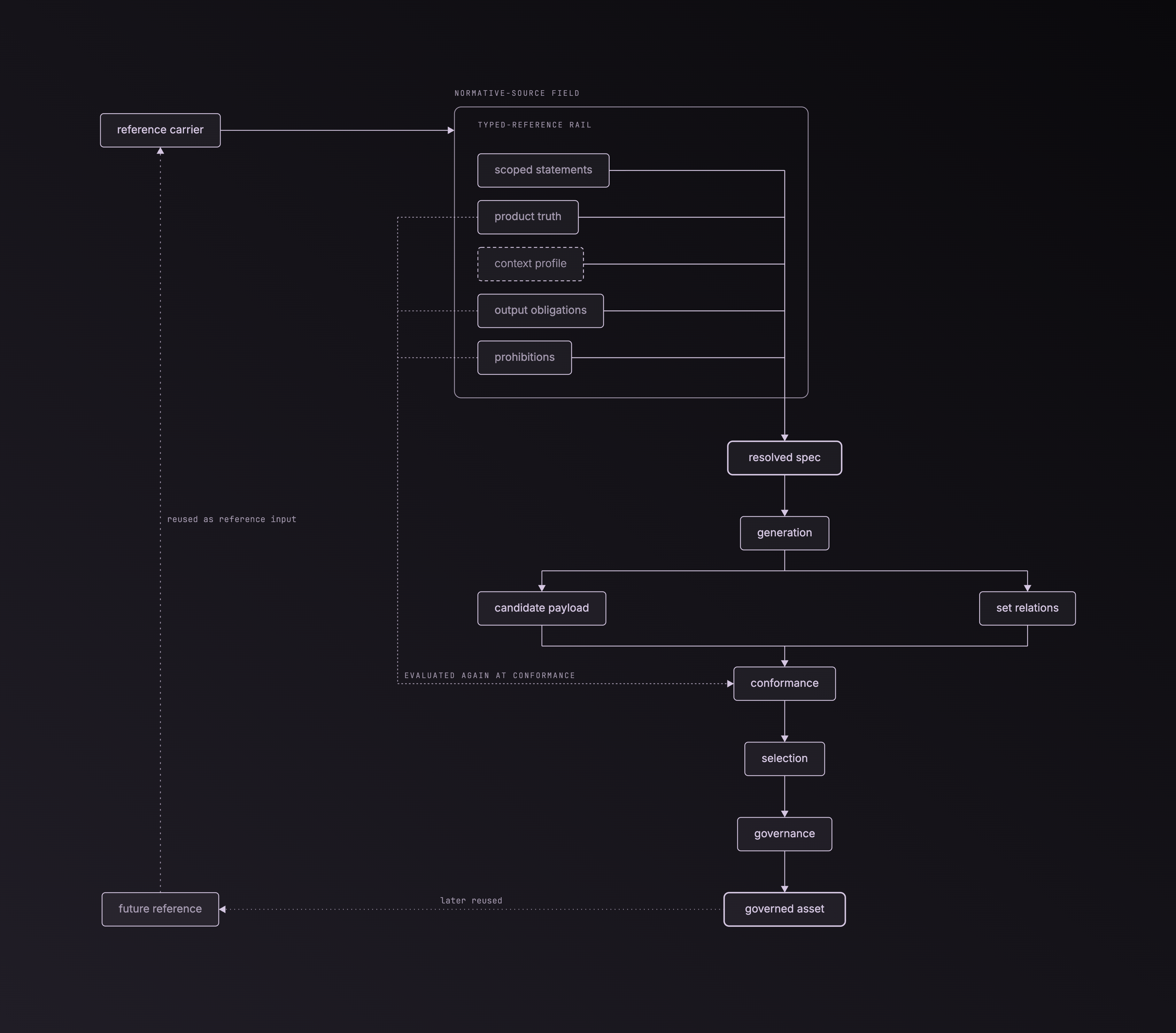
Visual Payload Architecture // a reference carrier can qualify the source field; source inputs converge into a resolved slot specification; the result is generated, evaluated, selected, governed, and may later return as a reference input. Illustrative — this prose is source truth. Repo-native interactive version (hover/click for definitions): docs/diagrams/asset-pipeline-ASK_visual-payload-architecture.html.
Evaluation precedes selection; selection adjudicates; artifact governance binds — the record carries the trace. Governance does not require one stored record per dimension: a governed asset can record the accepted output, the selection judgment, the rationale, and the controlling specification / references, while some dimension-level evaluation stays implicit inside that judgment. The durable requirement is accountability across the lifecycle, not dimension-by-dimension storage.
Normative force
Force is visual dimension × lifecycle statement × normative force — a three-way
relation. It attaches to the statement or carrier, never to the dimension itself:
candidate lighting observation = descriptive
brand lighting rule            = directive
lighting prohibition           = constraint
lighting reference             = reference
selection finding (lighting)   = judgment
governed acceptance (lighting) = governance
The six force kinds are defined in
docs/normative-force-and-durable-layer-pressure-v1.md.
This is a bridge to existing vocabulary, not a new force model.
Language and setup
Many dimensions can be articulated as a relatively stable upstream grammar plus a
context-specialized setup — lighting is the clean case (a warm, soft register vs a
studio key vs an outdoor exposure). A language-versus-setup distinction was observable
in the two earlier corpus runs. Its ownership and placement in the architecture — that
the brand owns the upstream grammar and context owns the setup — remain architectural
claims, not something a blind corpus proves. This is the local form of the
method-level bounded generativity primitive
(defined and owned at method-ASK); stated here in AP terms only.
Language supplies the upstream grammar; setup narrows a context-specific aperture; and references and constraints can govern either layer. This is the visual-payload instance of a nested aperture — upstream aperture-setting, then a narrower context aperture, then nonjudgmental realization within it.
What the corpus evidence supports — and does not
Two anonymized blind corpus runs predate this revision and tested the v1 flat
register. They did not produce or validate the ontology/topology correction. A later
terminology catch exposed the post-processing / retouch category error and prompted
the audit that produced v2. Their evidence is carried forward only where v2 retains
the same observable visual dimensions. Stated precisely:
Supported:
- the observed visual dimensions populate from real imagery, blind;
- recurring corpus-level visual regularities, consistent with a candidate grammar;
- the language-vs-setup distinction is observable;
- set-level coherence / consistency where sets were present.
Not established by the blind runs:
- that those regularities are authoritative, brand-owned grammar (that is an architectural assignment, not a blind-test result);
- product-fidelity conformance (no product truth was supplied);
- slot-obligation compliance (no obligations were supplied);
- prohibition compliance (not positively tested);
- ordered sequence / campaign-arc progression (only unordered family coherence was seen);
- the topology and force model (a population run cannot test relations).
The prior aggregate totals remain historical results of the v1 instrument; v2 does not carry them forward as current scores. A real conformance test needs specification
- product truth + candidate images — a new test class, not a rerun.
Earned and held
Earned by this artifact:
- the dimensions × lifecycle-roles ontology;
- normative sources separated from payload, in groups A / B / C;
- the convergence topology that preserves the Axis-B scope spine;
- references as the orthogonal carrier/function axis;
- obligations/prohibitions as both specification constraints and evaluation predicates;
- force as a statement-level (three-way) relation;
- the material-vs-finish and casting-vs-use boundaries; the explicit distinction between unordered family coherence and ordered sequence / arc progression.
Held, not decided:
- the IA home of the context profile (refines
mode-specificvs sits beside it); - completeness of the dimension set beyond two corpora;
- whether family coherence and sequence / arc progression become two separate dimensions;
- a conformance test class (specification + product truth + candidates), not yet run.
Boundaries
- structure, not schema: no fields, validator, or structured-IA revision proposed;
- aesthetic-agnostic; no real-brand examples;
- references remain the orthogonal function axis, not a peer visual dimension or an independent Axis-B source branch;
- the
bounded generativityrelation is stated in AP terms; no method doctrine is restated; - the normative-force section is a bridge to existing vocabulary, not a new model;
- no runtime or package-consumer implication is asserted;
- no new corpus run is in scope; the two prior runs are bounded as stated above, and any specification-based conformance test remains future work.
Self-superseding clause
This is the v2 articulation of the content axis. It supersedes
docs/visual-payload-architecture-v1.md, which
is preserved unchanged as predecessor evidence. v2 is superseded by any later version
that revises the dimensions, the lifecycle roles, the normative sources, or the
convergence topology.
Anchor documents
docs/visual-payload-architecture-v1.md— predecessor (preserved as evidence)docs/layered-reference-and-discretion-architecture-v1.md— the function-axis companiondocs/normative-force-and-durable-layer-pressure-v1.md— the six-kind normative-force vocabularydocs/creative-discretion-doctrine-v1.md— the bounded-generativity topology / creative-discretion doctrine; AP as a worked instance of the method-levelbounded generativityprimitivedocs/structured-ia-model-v2.mdanddocs/architecture.md— the Axis-B scope spine this artifact preservesdocs/foundational-premises-v1.md— references, product truth, and output are different objectsdocs/layer-disambiguation-note-v1.md— the project's four uses of "layer"docs/brand-intake-acquisition-and-blind-safety-v1.md— the corpus-construction preflight