

governed visual-payload information architecture
The domain architecture this repo develops, in three views of one object. Ontology and visual payload architecture are its principal views; inheritance is the orthogonal view that supports them. Its runtime axis, Axis D, has no dedicated diagram: the prose carries it, in the runtime layers of the architecture and in the layer note, which also keeps the earlier variation axis, Axis C, as historical.
ontology
Axis A — what kinds of information the definition layer structures: intent, inputs, constraints, creative discretion, required outputs, and governance. A branching classification, drawn as a horizontal cascade. Structural, asserting no maturity state.
visual payload architecture
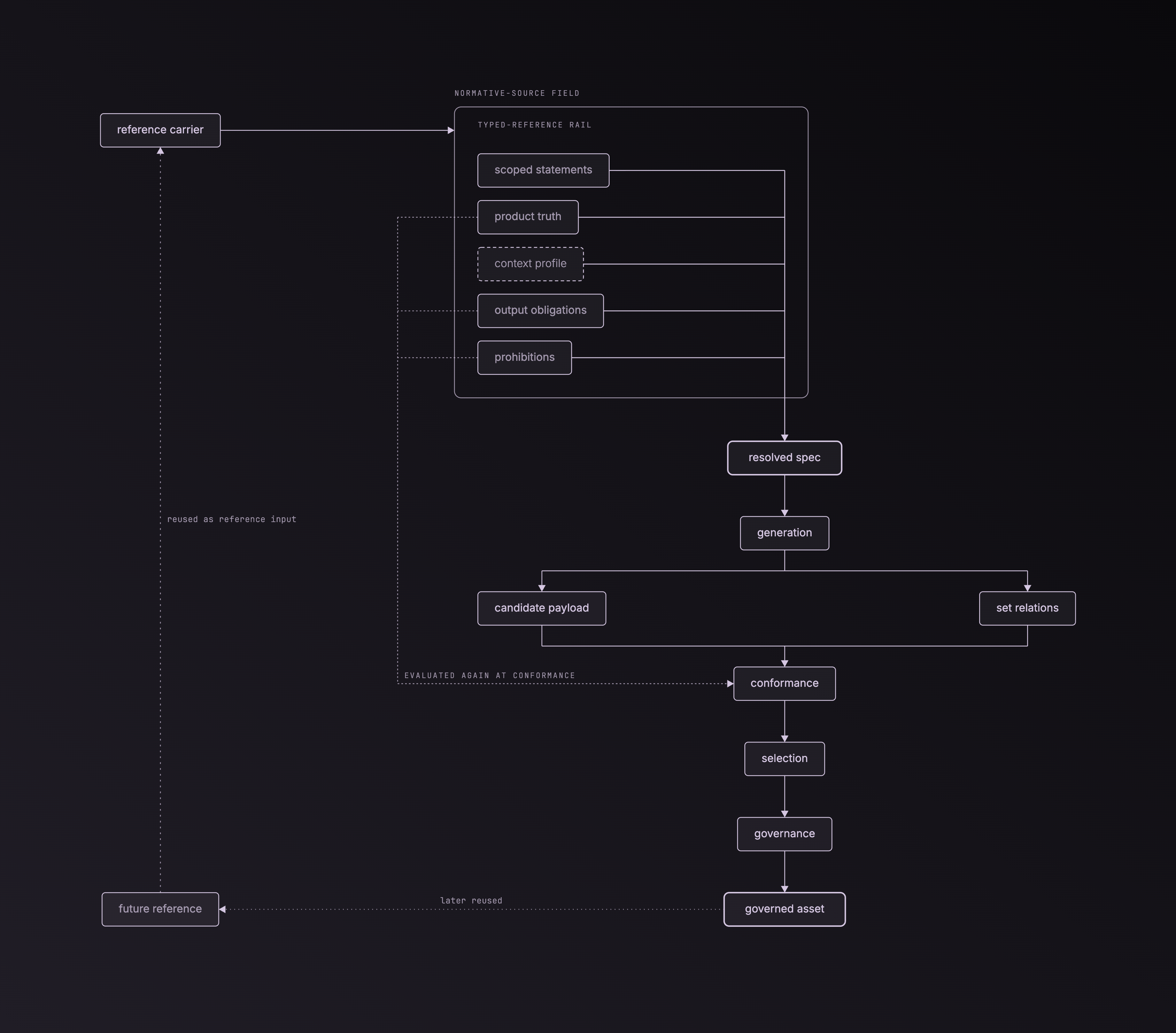
The convergence flow a commercial image's visual decisions move through — a reference carrier qualifying a normative-source field, the field converging into a resolved slot specification, realization reconverging into conformance, then selection, governance, and a return loop where a governed output can re-enter as a reference.
inheritance
Axis B — where information lives and how it inherits, overrides, and combines, from the brand-system layer down to the terminal slot. A linear chain, drawn as a centered vertical spine. The orthogonal partner to the ontology, deliberately a separate picture.
bounded generativity
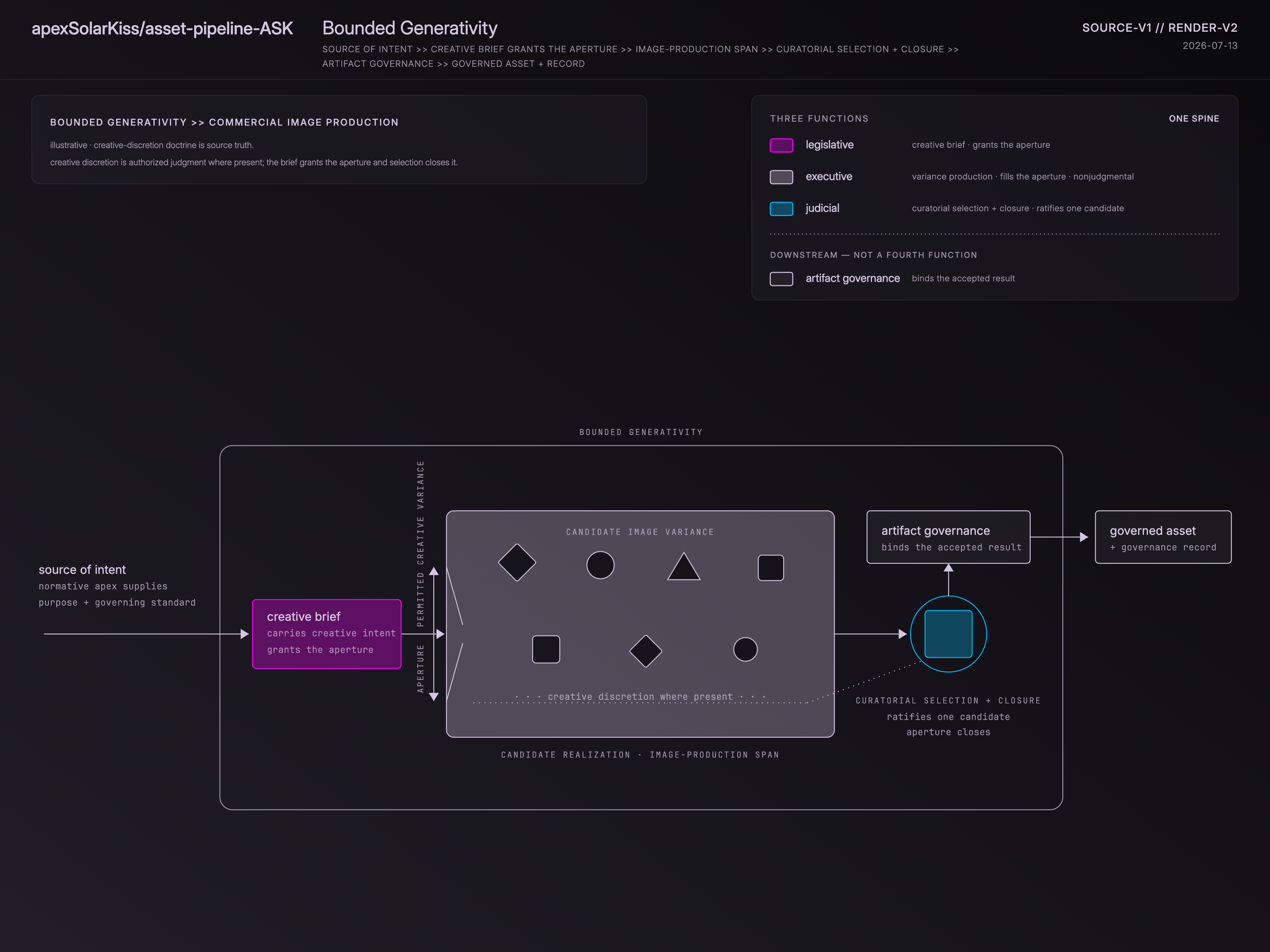
The system-model topology this repo instantiates: a source of intent outside the frame, a creative brief that grants the aperture of permitted variance, a bounded realization chamber, discretion exercised within the aperture, selection that ratifies one candidate and closes it, and governance that binds the result. A bracketed topology, not a linear chain.
architecture tree
Where the repo's surfaces live — the current architecture front door, the plateau state, the portability and extractability arc, the structured form and its consumers, and the application-layer outputs. A structural atlas of the project, not a maturity claim.
information architecture — state
The state view the structural diagrams deliberately omit: which surfaces, seams and open carrier-shape questions are earned, held or deflated, with the four workflow modes as orthogonal axes that selection isolates. Hover to preview, click to lock, and the inspector holds the evidence. Color encodes state only.
Drag to pan, scroll to zoom, and use the HUD controls in the bottom-left; ⤢ fits the figure. Theme follows the operating system, and the diagrams default to dark as repository documentation.
Each figure carries its authored content beside it — .source.js for the three engine-rendered patterns and the flow, .figure.js for the bespoke figure, .data.js for the state spine. Source advances when the authored content changes; the renderer advances only when its realization does.
Every figure exports on demand from its own HUD, in the resolved theme — PNG page for the chromed render and PNG diagram for the canvas alone. Two figures additionally keep one committed raster, because their governing prose embeds it directly; the PNG action on those two cards opens that committed file. The HTML and its authored content remain canonical, and the rasters are supplemental. See README.md for the full contents list and the refresh cadence each class follows.
These pages consume the vendored token mirror in _dsa-tokens/ and the surface carriers in _dsa-surface/, both pinned byte-identical to design-system-ASK and never hand-edited here.