

Creative Discretion Doctrine
on this page
The bounded-generativity topology the architecture preserves — creative intent ≠ creative discretion ≠ variance ≠ selection ≠ governance
Purpose / altitude
This is a high-level doctrine surface. It states, in one place, the bounded-generativity topology the architecture exists to preserve — asset-pipeline-ASK is the commercial image-production instance of that method-level primitive — and names where each distinction is detailed elsewhere. It is doctrine altitude — not a schema, not a proof-test, not a runtime. The structured definition layer and the architecture docs implement this topology; this note states what they are for.
The five load-bearing distinctions can be read in functional order — creative intent → creative discretion → variance → selection → governance — but that ordering is a function-order projection, a reading aid, not the system's shape. The system-model topology is bracketed rather than linear; its functions retain an ordered reading (see below).
It expands foundational-premises-v1.md premise 5 ("creative discretion is a structural concern, not a residual") into the full topology that premise sits inside.
The bounded-generativity topology
asset-pipeline-ASK is the commercial image-production instance of bounded generativity. The model is a bracketed topology, not a linear handoff:
- a human or institutional source of intent / normative apex sits outside the bounded frame and supplies purpose plus the governing standard; its source-of-intent role adopts or authorizes that standard and is the constitutive legislative source (the role is what is classified, not the person or institution occupying it);
- the creative brief carries creative intent and that standard into operative scope — delegated legislative apparatus — and grants the aperture of permitted creative variance, a bounded permission rather than apparatus;
- candidate realization fills the aperture with variance across the image-production span; the variance-producing operation is nonjudgmental;
- creative discretion enters wherever an authorized decision-maker evaluates admissible alternatives against the governing standard and binds within scope — potentially in authoring or authorizing the brief, within realization, and at selection;
- curatorial selection ratifies one candidate and closes the aperture;
- artifact governance binds the accepted result;
- the durable output — a governed asset + governance record — sits outside the frame.
The load-bearing distinctions the topology keeps legible, stated as non-identities:
creative intent ≠ creative discretion ≠ variance ≠ selection ≠ governance
Read in functional order they are creative intent → creative discretion → variance → selection → governance — a reading order, not five stage-equivalent boxes. Each is defined next.
- Creative intent — the aim: what the asset is meant to express. The normative layer, where source of intent lives.
- Creative discretion — the bounded, reviewable judgment exercised under the governing standard: in shaping or authorizing the brief that grants the aperture, in judgment-bearing intervention within realization, or at selection and closure. It is weak discretion — judgment exercised within standards (intent, constraints, references, output role, decision owner), not freedom from them. The aperture is the permitted variance granted by the brief / source-of-intent package and owned through its decision path.
- Variance — the candidate spread produced inside the aperture. The variance-producing operation fills the aperture; it does not evaluate admissible alternatives against the governing standard and bind. (Variance is technical; discretion is normative.)
- Selection — the curatorial closure gate that chooses one realized candidate, closes the aperture, and makes the result true to the intent. It is judgment-bearing, but not the whole of authorship.
- Governance — artifact governance: the mechanism that binds the accepted artifact to its claim, permitted use, circulation, approval, and answerability. The governance record — capture, provenance, curator, rationale — is its durable trace and stated basis, not the governance function itself.
The topology names functions, not a single physical handoff: the variance-producing / synthesis spans may be plural and distributed across the process, and discretion may enter before, during, or after any of them.
Compact: the source-of-intent role legislates as constitutive source and the brief as delegated apparatus · realization executes · the curator adjudicates · artifact governance binds — and the governance record carries the trace.
Why the distinctions are load-bearing
- intent ≠ discretion. Intent is a direction; the aperture is permitted variance granted by the brief / source-of-intent package; discretion is bounded judgment exercised within that granted aperture and at closure. Holding intent fixed, the brief can widen or narrow how much room the executor has — and that latitude is owned by a decision owner. Collapsing intent and discretion into one "creative direction" field is the ambiguity the architecture exists to remove, and the one a machine cannot resolve by inference.
- discretion ≠ variance production. Creative discretion may enter before, during, or after realization. The variance-producing operation itself is nonjudgmental. A span is judgment-bearing only when an authorized human or computational decision-maker evaluates admissible alternatives against the governing standard and binds within scope; human presence or authorization alone is insufficient, and current model sampling does not qualify.
- variance ≠ authorship. Randomness, sampling, and seeds produce candidates; they do not author. Selection is the curatorial closure gate, not the whole of authorship. Authorship may be attributable through source of intent, bounded discretion, judgment-bearing intervention, selection, and closure. Artifact governance preserves attribution and recourse; it does not create authorship.
- selection ≠ aperture-generation. An active selection gate does not certify the topology upstream of it. Selection chooses among candidates; it does not establish who authored the aperture that made those candidates available. If aperture-generation migrates into the execution layer — the candidate space effectively set by the model rather than by the brief's granted aperture — the authorship structure has eroded even while selection keeps running, because selecting feels the same either way. This is why the aperture is an explicit, package-authored object in this architecture: the definition layer keeps the aperture's origin legible, so selection closes an aperture someone granted rather than ratifying one nobody did.
- selection ≠ governance. Selection closes the aperture and makes the result true to the intent; artifact governance governs the accepted artifact's claim, use, circulation, approval, and answerability. The governance record is the durable trace of that mechanism, not the mechanism itself. A generated image is not automatically a governed asset.
- fabrication provenance ≠ authorship record. The governance record preserves two distinguishable chains. Fabrication provenance records how the artifact came into being: the tool, model, run, source references, edits, file lineage, permissions, and custody. The authorship record locates the governing aim: what the artifact is for, what it is meant to express, under whose authority it exists, what standard governed the variation, who selected, who accepted, and who answers. Neither derives from the other: a complete fabrication chain does not locate authorship, and an authorship record does not specify every fabrication act. The definition layer carries the aim / authority / answerability structure; capture into the governed record preserves both chains without collapsing them.
- judgment does not propagate through synthesis. Judgment-bearing inputs do not make a nonjudgmental aggregation, synthesis, generation, or model pass judgment-bearing. A synthesis becomes judgment-bearing only when an authorized human or computational decision-maker evaluates admissible alternatives against the governing standard and binds within scope. This guards brand ingestion and candidate generation alike: source material may embody the results of earlier judgment and preserve evidence of prior choices, but the synthesis does not inherit the authority of its inputs by the act of synthesizing. It still can — a synthesis output becomes an authorized carrier only by passing post-ingestion validation / correction against the source of intent and being bound, never by synthesizing alone. ("Judgment does not propagate" is not "synthesis can never inherit authority" — it inherits authority only through validation / correction / binding.)
- source of intent ≠ decision owner ≠ authorized decision-maker. The source of intent supplies purpose and adopts or authorizes the governing standard. The brief carries them into operative scope in the production topology and grants the aperture. A reference or other source material that carries intent is legislative only where it acts as the brief, rule, or grant; standing intent (adopted normative content), and storing, citing, routing, relaying, or preserving it, perform no legislative function. The decision owner owns the granted aperture, its closure, answerability, and recourse, but does not set the aperture. The authorized decision-maker evaluates and binds locally within a delegated scope. These roles may coincide but need not — substrate-neutral on who may decide, strict on where answerability remains. A computational agent may occupy the authorized-decision-maker role only by the functional test above; current model sampling does not. Aperture ownership means accountability for a granted latitude and its closure, not authorship of the bounds themselves.
These distinctions keep the governing intent connected to what may be generated, how candidates are judged, and what may be accepted as the asset. Collapsing them can let the model set the candidate space the brief should have granted, or let selection ratify a persuasive candidate without establishing that it fulfills the intended work. The loss is operational as well as evidentiary: the pipeline can keep producing while its outputs drift from the purpose and standards meant to govern them. Artifact governance binds the accepted result to its claim, permitted use, and answerability; the governance record preserves the basis. Neither substitutes for directing the work or judging its fitness in the first place.
AP as a worked instance of a method primitive
asset-pipeline-ASK is the commercial image-production instance of the method-level primitive bounded generativity: define a grammar, permit bounded variance inside it, select from the realized candidates, and govern what becomes durable. The primitive is defined and owned at method-ASK/docs/bounded-generativity.md, on a legislative / executive / judicial spine (weak discretion in the Dworkin sense); that grounding lives in the method doc and is not restated here. The general governance architecture is owned at method-ASK/docs/governance.md; AP instantiates its artifact-governance subtype and carries a governance record as the durable trace.
AP's five distinctions are the domain-language articulation of that topology: the creative brief carries creative intent, the governing standard, and the aperture grant; realization produces candidate variance; creative discretion names authorized judgment wherever it enters; curatorial selection ratifies one candidate and closes the aperture; artifact governance binds the accepted result; and the governance record carries the trace. One topology, not two structures.
asset-pipeline-ASK is the worked instance with governance built out first-class — the full topology through to the governed-asset record. It is not the primitive's owner. The cross-ecology relation (the same structure in isometric-cubes-ASK, mazeASK, this repo, and generative-AI workflows generally) is recorded at the ecology tier; isometric-cubes-ASK and mazeASK are antecedent studies, not dependencies or imports of this repo.
Where the topology is carried in this repo
This doctrine names the topology; the surfaces below carry the detail. The doctrine does not duplicate them.
-
the topology, illustrated — the bounded-generativity figure (
docs/diagrams/asset-pipeline-ASK_bounded-generativity.html) instantiates the method-ASK bounded-generativity topology in AP vocabulary. Per an ASK apex ruling, the shared invariant across the AP and method figures is the topology, the semantic-role mapping (legislative / executive / judicial), the Three Functions treatment, and the governance boundary — not pixel-identical geometry; under Three Functions v0.2 that mapping makes the source-of-intent role (constitutive) and the brief (delegated) legislative in both figures; AP adapts copy and geometry for the commercial image-production surface, withmethod-ASK/docs/bounded-generativity.md(@2e5d8c4) as the upstream conceptual and design provenance. Illustrative orientation only: this doctrine prose is source truth, not the figure, and the topology is not a runtime schema, validator, grammar, or orchestration flow.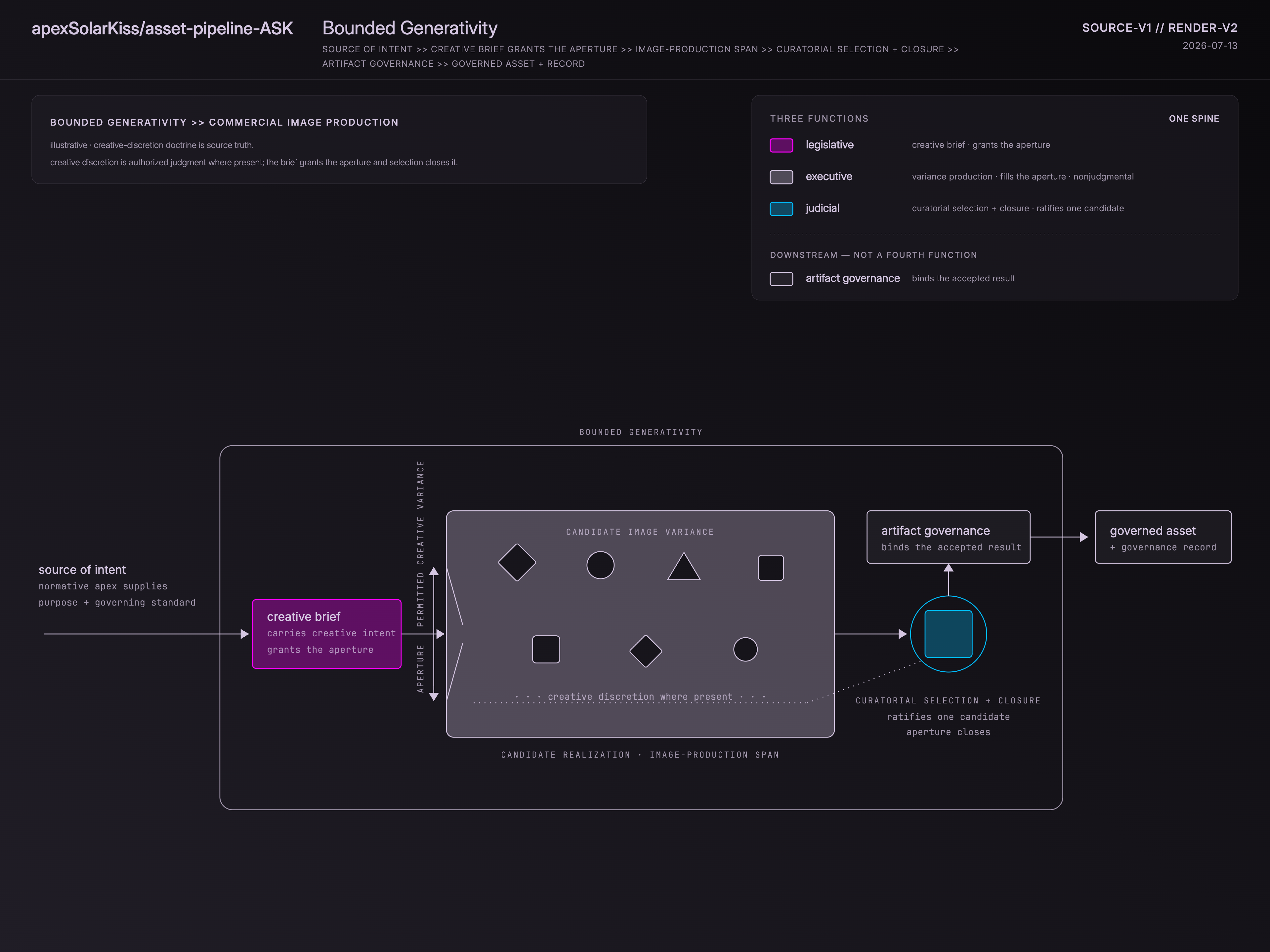
-
kinds of information (intent · inputs · constraints · references · outputs · governance) — the definition-layer ontology (Axis A); see layer-disambiguation-note-v1.md and the ontology diagram (
docs/diagrams/asset-pipeline-ASK_ontology-tree.html, which draws the intent → discretion relation). -
creative discretion as structural — foundational-premises-v1.md premise 5.
-
the nine discretion sites + reference-function taxonomy — layered-reference-and-discretion-architecture-v1.md.
-
the curation semantic split (authorship-bearing discretion, variable site, vs governance-bearing curation, always at the seam) and generated ≠ governed — architecture.md.
Public articulation
The public statement of this model is the article Creative Discretion Is Not Creative Intent (2026-06-06). That is the externally-voiced articulation of the intent/discretion distinction; this note is the repo-internal, systemic statement of the same model.
Boundaries / status
- Doctrine altitude. Not schema, proof-test, or runtime; the embedded figure is illustrative and doctrine-subordinate. It authorizes nothing operational.
- AP is a worked instance, not the owner.
method-ASKis the primitive's home; cite it as such. - Source of intent is human / institutional in the worked AP implementations. Source of intent, decision ownership, and ultimate recourse remain human / institutional. A computational agent may exercise bounded delegated judgment without thereby becoming the source of intent or owning ultimate recourse; current model sampling fills the aperture and does not author the intent that opened it.
- Held: qualitative equivalence. This model locates where judgment, selection, and governance occur; it does not settle whether the locus, density, latency, or binding authority of judgment changes the strength or character of authorship across delegated patterns (e.g. live human judgment in the making vs a human curating a model pass). That qualitative-equivalence question is held upstream, not resolved by the curation seam — the architectural placement is settled; the evaluative consequence is open.
- Starting doctrine the architecture builds on; not re-proved by routine work. It exists so the model can be cited once, plainly.